Home EV Charging: What You Can Do Yourself and When to Hire an Installer
If you have a driveway, charging at home is usually the easiest way to run an EV. You can handle the planning and product choices yourself, but the fixed wiring is work for a registered electrician.
Parking comes first
Home charging depends on where you park. With off-street parking next to the house, a wallbox can replenish the energy used on your daily journeys while you are at home. The amount it adds depends on your car, the power available and the hours spent plugged in.
Drivers with a garage or driveway may be able to use an overnight electricity tariff. For flats or terraces without allocated parking, the situation takes more thought. Don’t improvise by trailing a longer cable across a pavement or shared path. Discuss any proposed installation and permissions with a qualified installer and the relevant property owner or local authority. Public or workplace charging may be the more practical main plan.
Be honest about your parking before you shop for hardware. A photo of the parking spot and the meter box will help an installer quote faster.
If you rent, get written permission before you book, because most landlords will want to see the installer’s credentials and how the cable run will look once the work is done. Keep that written permission handy. It saves arguments later.
Jobs you can safely own yourself
There’s plenty you can do without touching electrics. You can decide where the car will sit each night and how the cable will reach it without a trip hazard. Measure that run, allowing for any gate or carport the cable will need to pass round or under.
Product choice is also yours. Tethered units have a cable attached, while untethered units use a separate lead you plug in. With a tethered unit, the cable is ready whenever you park. An untethered unit lets you remove and store the lead between sessions. Check compatibility with your car and think about how easily you can reach its charging port in your usual parking position.
You can also look at the practical details that make daily use easy. Check the proposed charger’s connectivity requirements: some use wifi, while others offer mobile data or a wired connection. Your phone’s wifi signal at the proposed location can be a useful starting point, though it isn’t a complete test. If you want an EV electricity tariff, check the supplier’s supported cars and chargers before ordering equipment. App control or a particular communications protocol doesn’t by itself guarantee tariff compatibility.
Take photos in daylight from two angles. One should show the meter box with the door open if you can open it safely. The other should show the wall where the unit would sit and the ground between. Send both with your quote request so the installer can see if the run is long or the wall needs extra work.
You own the decisions that affect daily use. The electrician assesses the supply and handles the electrical design and safety checks.
Why a normal socket is not a charging plan
A lot of new owners ask about the portable charging equipment that plugs into a 13A socket. It’s sometimes called a granny charger or Mode 2 lead. Having one in the boot doesn’t mean that any available socket is suitable for charging, even for a short stay.
Electrical Safety First’s EV guidance explains that standard sockets and wiring may not suit the extended load of charging. It recommends a dedicated home chargepoint installed by a registered, competent electrician qualified for EV work.
Before relying on portable equipment, follow the car and equipment manufacturers’ instructions and have a qualified electrician assess the intended socket and circuit. Don’t improvise with extension leads, adaptors or damaged cables. A visual check for cracks or heat marks is useful, but it cannot establish that wiring hidden behind the socket is suitable.
If you notice damage, discolouration or a burning smell, stop using the equipment and arrange professional advice. Don’t replace the socket faceplate yourself and assume the issue is solved. The fault may be elsewhere in the circuit. Planning an alternative public charging stop is better than making an unsuitable socket your fallback.
Why a wallbox is fixed electrical work
A wallbox is a fixed installation that can draw a substantial load for hours. Mounting the box is only one part of the job. Its circuit, protective devices and connection to the property’s supply all need professional design and assessment.
The installer will check the consumer unit and the available supply capacity. There may be other significant loads, such as electric heating, showers or cooking equipment. The answer isn’t necessarily a bigger supply: your installer can explain whether an appropriate charger with load management would suit the property. Don’t buy equipment on that assumption without discussing it first.
Earthing and fault protection also need attention. The protection must suit both the property’s electrical arrangement and the chosen charger. These aren’t decisions to make from a product description or an online wiring diagram. Ask the installer to explain any additional equipment in the quote in plain language, including what it does and why it is needed.
Photos help with planning, but they don’t replace the necessary site assessment and tests. Make access available to the relevant electrical equipment when arranging the survey.
The cable route affects cost and safety too. A short route may need less work than one around a patio or several walls. Agree the proposed route and appearance, but leave cable selection, protection and electrical design to the professional. Don’t start digging or drilling before that route has been assessed.
If you can’t charge at home yet
Not every home is ready on day one. You might be waiting for a meter move or an installer date. You might have no off-street parking at all. You still need to get to work.
Many drivers top up at public ev charging stations near shops and everyday destinations while they arrange a home installation or when a home charger won’t suit the property. That backup keeps you moving without rushing the electrical work at home.
Map the public sites you can use during a weekly shop or a gym visit. Check compatibility, access hours, payment and parking restrictions, then save another reachable site as a backup. That gives you a workable routine while you arrange the home side at a steady pace.
When to hire an installer
Hire an appropriately qualified installer for any fixed home chargepoint, not only when the electrics look old. Tell them about known faults, previous alterations or a shared supply. If sockets show heat damage or you notice other electrical problems, arrange an assessment before using them for charging.
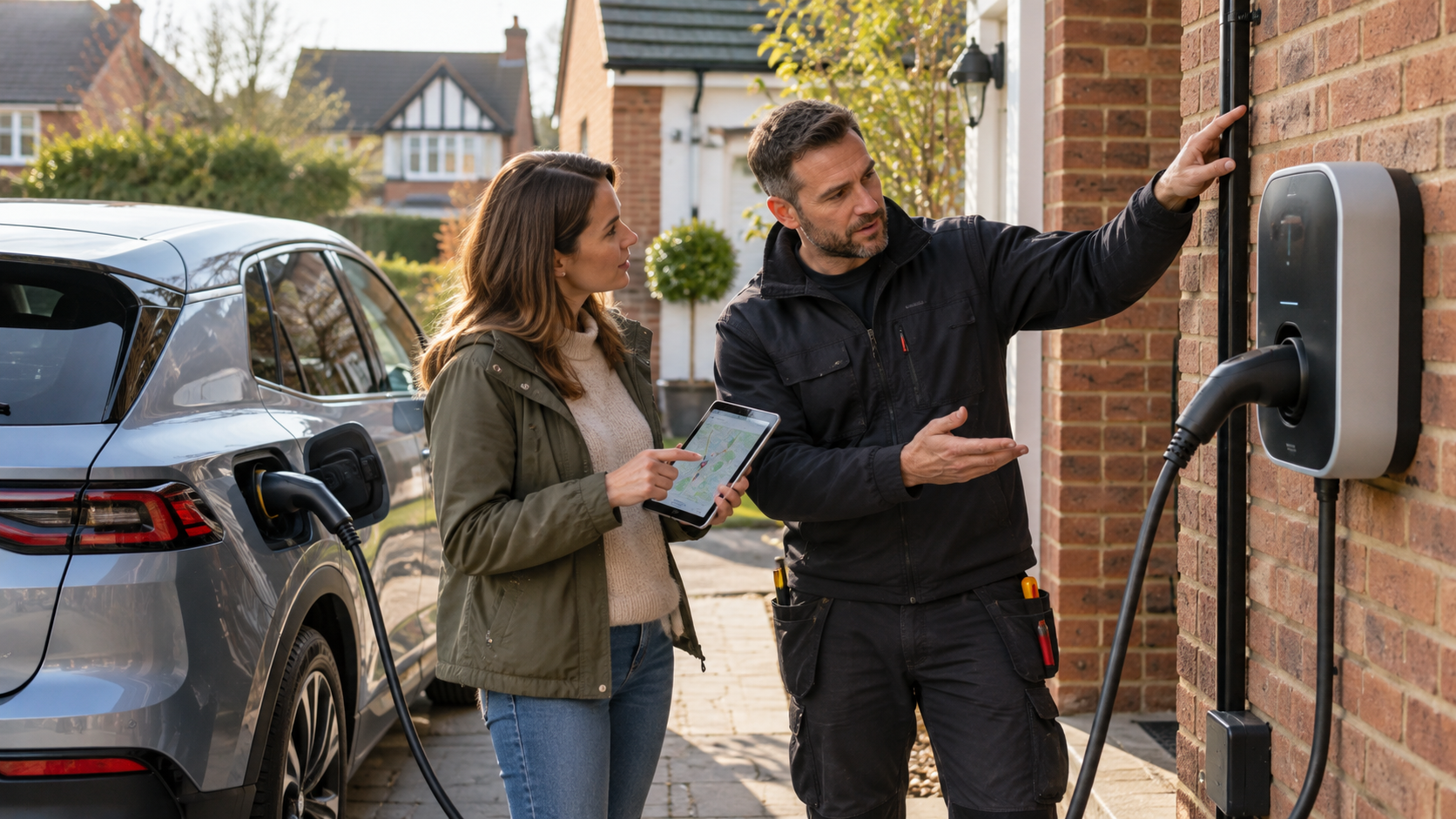
A good installer will start with a survey. They will look at the supply fuse, the consumer unit, the earthing setup and the cable route from meter to charger spot. They will tell you if you need a board change or a longer cable run round the house. There’s no shortcut here.
Testing and paperwork come with the job. The installer will check insulation resistance and earth loop readings, then test whether the RCD trips in time. You should get an installation certificate for the new circuit. Keep it safe. It is not the same as a periodic inspection report for the whole house, which looks at existing wiring rather than the new work.
Look for a registered, competent electrician with specific qualifications and experience in EV chargepoint installation. Check their registration through the relevant scheme’s directory rather than relying only on a logo in an advert. Ask who handles the distribution network operator’s notification and whether any approval is needed before work begins. Electrical Safety First says the DNO must be informed when a chargepoint is connected, and the installer should be able to handle this on your behalf.
Ask how long the survey takes and what photos to send first. Find out whether the quote covers drilling and testing too. Clear answers now help avoid surprises on the day.
Speed and smart settings still sit with you
Discuss charging speed with the installer before buying hardware. A higher number on the box doesn’t necessarily mean your car will charge faster: the car’s AC charging limit and the property’s available supply both matter. Start with your daily mileage and the hours you usually park at home, then ask what output will comfortably replace that energy.
A household doing short daily trips may need less power than one sharing a charger between two high-mileage cars. Allow for future plans, but don’t pay for an output your car cannot use. Ask whether any proposed upgrade is essential or simply an optional way to increase charging capacity.
Smart controls are useful after installation and commissioning. Follow the charger’s instructions to set up the account, confirm connectivity and learn how to start or stop a session. If solar integration is important, ask about it before purchase; app control doesn’t automatically include that feature.
Schedule charging around your actual tariff’s cheaper hours, which may not start at midnight. Choose whether the car, charger or energy supplier controls the schedule so conflicting settings don’t prevent charging. Check the first few sessions to see whether they worked as intended, and keep a simple way to override the schedule when you need to leave sooner.
Compare the full installed job
Don’t shop on the box price alone. Two quotes for the same charger can differ by a lot once labour is added. Ask what is covered for the cable run and the certificate. A short run on a modern board costs less to put in than a long run round a garden with a board change.
Look for clear quotes that specify the charger model, planned cable route and what labour, materials, testing and certification are included. Ask about any extra costs if the survey identifies further work, and clarify who provides support for the hardware and the installation. If a quote is vague, ask for a written breakdown before agreeing.
Prepare the site before the van arrives. Clear the parking spot and the path to the meter, and cut back plants round the wall where the unit will sit. Make sure pets are shut in. Take a final photo of the clear run so there’s no doubt.
You can do a lot to make home charging work well. Pick the spot and the tariff that fits your miles. Leave the circuit and the sign-off to someone registered to do it. That split keeps daily charging simple and the house safe.